
AUDIOPHILE AUDITION
by Steven Ritter
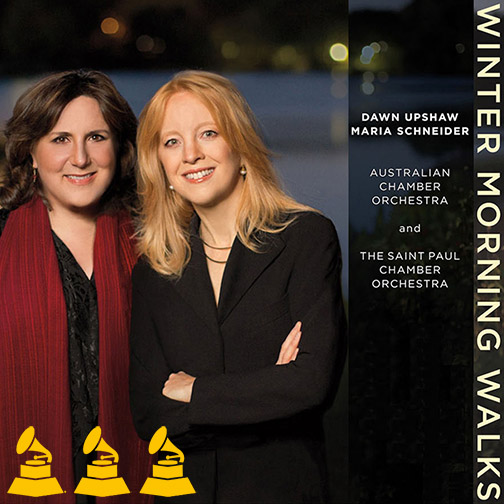
"WINTER MORNING WALKS" (buy here)
____________________
Classical Music Review by Steven Ritter
This is a phenomenal recording. Enough said. *****
Maria Schneider strikes me as a highly intuitive composer. There is structure to her music, yet not; continuity yet never bound to any particular formal scheme; and most of her music has that unassailable feeling of sounding "right" for no other reason than she has willed it so and wanted it that way. Her muse is very much in the moment-when I listen to her compositions I am not really looking forward to what's down the line in the way that hearing Beethoven almost demands anticipatory suspense and final resolution.
Of course, she is primarily a jazz musician, having formed her own big band/orchestra in 1993, and leads it like a conductor in front of a symphony orchestra. Jazz has its own rules, and though this album under review does confound the idea of labels as such, DOWNBEAT MAGAZINE doesn't give composer awards–as it has to her in three consecutive years from 2010-12–to purely "classical" composers. So we do need to start with a frame of reference.
Her originality in the field has managed to stretch the confines of jazz into something new without resorting to the avant-garde. Years ago people like Anthony Braxton, Miles Davis, John Coltrane, and Ornette Coleman were breaking all sorts of barriers in imitation of the classical composers before them who had also considered their art form to be running into a dead end. The thing is, no one, aside from some real diehard fans, listened; and in the meanwhile people like Chick Corea moved into the rock genre sound-wise and attracted new audiences. Today we look at the work of Coleman at al with a lot more sympathy the same way the Schoenberg's music has, in many ways, become familiar, accepted, and even loved in some quarters. But those days are gone, and the radicals cannot be returned to. So what is a jazz composer to do?
One answer is to simply move backwards the way an artist like Wynton Marsalis has, playing the oldies, or the imitation oldies with unalloyed perfection. Another seems to be the road Schneider has taken, incorporating innate musicality comprised of her entire musical experiences since a child, and not fearing to tread onto new turf. This isn't new; even here people like Duke Ellington and Stan Kenton were paving the way before Schneider was born, and I would be startled to hear if those two didn't have an influence on her. But when I listen to a piece like her GRAMMY-winning "Cerulean Skies" I am hearing jazz, Copland, folk structures, sentimentality, pessimism, optimism, and a feeling that most of all reminds me of Roy Harris in his curious ability to project the fears and hopes of the American land in a way that few others could.
But on this album, we move away from jazz, almost completely, or at least no further into it than many other American and European composers hearkening only to hints and surface similarities, despite the presence of improvisation, which classical music actually claims first rights to anyway. And when one has Dawn Upshaw at her disposal, it's no easy turn to "not" write directly for a voice as versatile and spectacular as hers. So we have two song cycles, both similar and superb music, thought "Winter Morning Walks" may be a masterpiece, with "Carlos Drummond de Andrade Stories" gently nipping at its heels. And who is Carlos Drummond de Andrade? One of Brazil's top poets, discovered by Schneider a long time ago as she has an affinity for that country, yet brought home during her first visit 15 years ago. This performance is dedicated to her father, who evidently loved the piece and hoped to hear more; he would not, though more was forthcoming.
And it appeared int he guise of "Winter Morning Walks." These poems, just nine out of what poet Ted Kooser says are hundreds, and succinct and pithy in content. He began writing them when recovering from cancer surgery and having to stay out of the sun. His many morning walks inspired him to finally start reading and writing abain, and he put these small vignettes on a postcard and sent them to a friend, one by one. Schneider's music perfectly captures the mood of these writings, and is supplanted by Dawn Upshaw's radiant singing, almost ecstatic utterances that give primary and forceful precedence to the melodic line, while a lot of the movement of the music actually occurs way underneath in the orchestra. It's a great concept and a highly sophisticated and moving sound.
Watching a few YouTube videos of Schneider being interviewed show her to be a very unassuming composer, even anti-intellectual in the way she approaches her art. In other words, despite the complexity of much of the music, there is far more heart than head in this artist's oeuvre. Both the chamber orchestra, highly regarded each, play beautifully, and one can only hope that this marks a beginning of Schneider's entrance into even more orchestral music in the future. She is an important composer for sure, and I regard this album as the most important set of song cycles since Andre Previn's "honey and Rue" and Peter Lieberson's "Neruda Songs"–and that is exceptionally high praise.
When you hear "American Crow" trumpeter Mike Rodriguez and "A World Lost" guitarist Jeff Miles against the direly dramatic backdrop and darting heft of the Maria Schneider Orchestra, it's a chattering conversation of feeling blues and seeing reds. Yet there's beauty when those reds and blues are mingled into something purplish and gorgeously epic. link to full article
- JAZZTIMES – A.D. AmorosiThis new EP, expansive enough to rival a full-length release, arrives not as a minor statement but as a fully formed meditation. ... In the slow arc of its harmonies and the lift of its final ascent, the music leaves behind not just resonance, but room, room to reflect, to question, to feel the air shift overhead. Read full article translated from French to English
- Paris-Move – Thierry De ClemensatSome protest music needs to scream in order to make its point. This is at the other end of the spectrum: a protest music that, by making its point through a demonstration of humanity, is no less eloquent. read full article
- TheBlueMoment.com – Richard Williams“Data Lords” . . . is her magnum opus, a riveting, remarkably intense double album, as profound as modern-day instrumental music gets. Link to article
- MINNEAPOLIS STAR TRIBUNE – Jon BreamNow it's finally here, in the form of a magnificent double album, Data Lords . . . it parses into thematic halves, "The Digital World" and, as an antidote, "The Natural World." On the whole and in the details, it amounts to the most daring work of Schneider's career, which sets the bar imposingly high. This is music of extravagant mastery, and it comes imbued with a spirit of risk. Link to article
- NPR.com – Nate Chinen“The Digital World” emerges as her manifesto against everything that limits the expressive range of the human spirit. “The Natural World” becomes a summarizing afterword in Schneider’s musical autobiography that illustrates the natural forces that keep her creative compass pointing true north. Link to article
- The Arts Fuse –– Allen MichieData Lords: Schneider’s craft and judgment are such that music in the eerie, dystopian world has the marvellous feeling for structure, pacing and often sheer beauty that listeners who know Schneider’s music will be expecting. . . .
There are instrumental glories throughout this album, but the work of the low brass both as section and as individuals is quite unbelievable and is caught exceptionally well on the recording. Whereas Wagner once said “don’t look at the trombones, it only encourages them", I had the sense that Maria Schneider must keep looking at the trombones a lot. And they certainly deliver here. Link to article
- TheArtsDesk.com – Sebastian ScotneyWith Data Lords – a steeliness and even bleakness now shares a stage with her familiar pastoral side. . . . The inner tensions behind this compelling session promise a revealing new phase in Schneider's remarkable work. Link to article
- THE GUARDIAN – John FordhamBeyond the dualism in its format, Data Lords is a work of holistic creativity. The music of outrage and critique in the first album has all the emotion and conceptual integrity that the music of melancholy and reverence does in the second. I can’t conceive of anyone else creating this music, unless Delius has been writing with Bowie on the other side. Link to article
- THE NATION – David HajduData Lords: Disc One offers highly imaginative, revelatory, at times breathtaking music as in the title track. . . . Expect this project, at a minimum, to be a Grammy contender with perhaps historic recognition in the wings at some point. Link to article
_________________________
The Thompson Fields: “... this magnificent, nature-drunk masterpiece, one of the great jazz records period, not just one of the great recent jazz records.”
- THE BUFFALO NEWS – Jeff SimonMaria Schneider wanted to send a strong message about the threat of a mass manipulation of humanity with Data Lords. Through her high standard for meticulous composing and arranging, delivered by some of jazz’s best musicians, she gets the message across in perhaps the grandest way possible.
- SomethingElseReviews.com – S. Victor AaronThe Thompson Fields: ***** "...there is nobody more capable of harnessing emotions in music and projecting and preserving the beauty and power of the natural world in sound than Maria Schneider. She's demonstrated that time and again, and she does it once more on this awe-inspiring release."
The Thompson Fields: "This marriage of sounds, words and images is ultimately breathtaking, a testament not simply to the hipness of jazz but to the uplifting and sustaining powers of art."
- OTTAWA CITIZEN – Peter Hum


